


Best law firm in Coimbatore/ Best advocates in Coi...
2024-04-02T07:11:10  read more
 read more
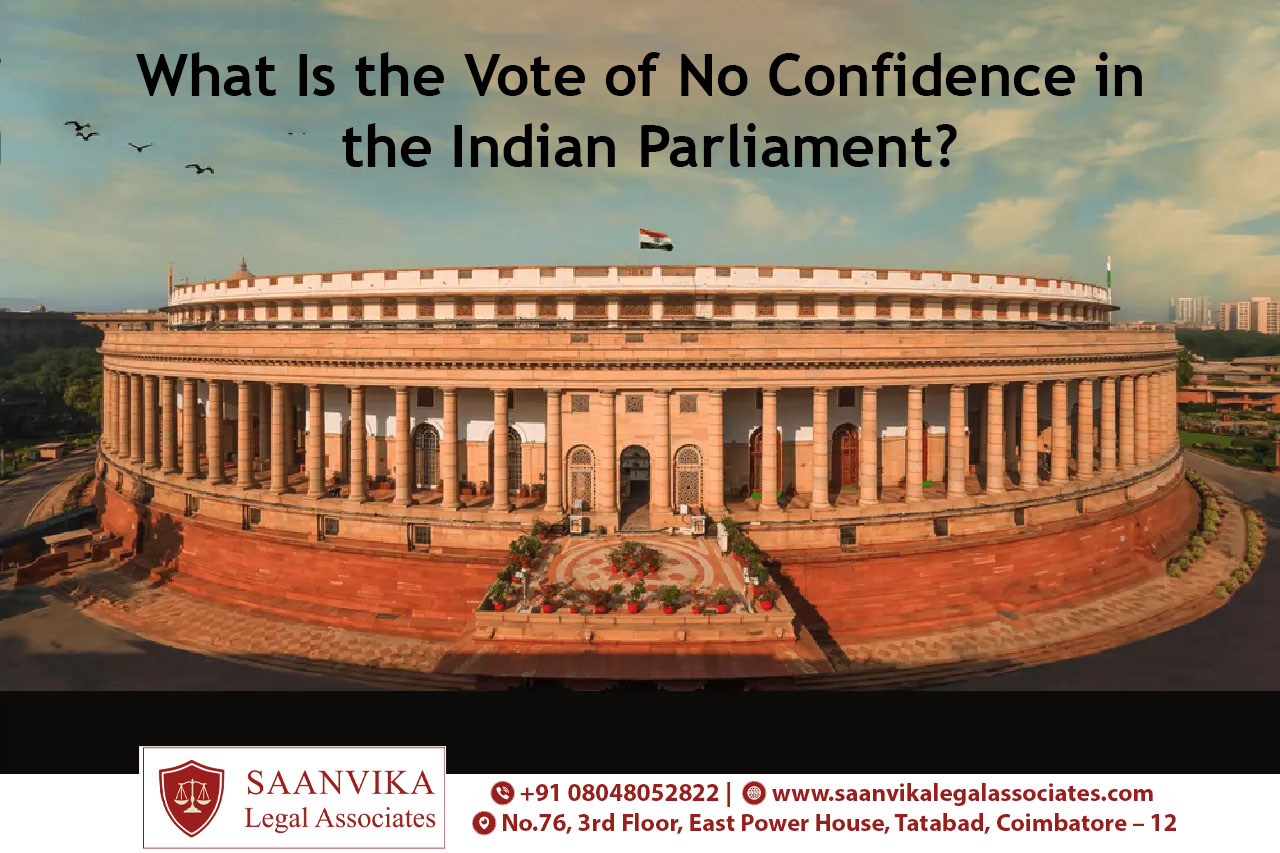

Vote of No Confidence/ Indian parliament/ Vote of No confidence in Indian Parliament/ Parliament/ vote/ No confidence voe/ Best law firm in Coimbatore/ Best advocates in Coimbatore/Best law service in Coimbatore/ Best legal consultation in Coimbatore/ Best legal services in Coimbatore/ Best lawyers in Coimbatore/ Online legal consultation. The "Vote of No Confidence" in the Indian Parliament is a constitutional mechanism by which members of the Lok Sabha, the lower house of India's Parliament can express their lack of confidence in the Council of Ministers (the government) headed by the Prime Minister. It is an essential feature of India's parliamentary democracy and serves as a check on the executive branch's power. Here's how the Vote of No Confidence works in India: A Member of Parliament (MP) can submit a formal notice of a No-Confidence Motion to the Lok Sabha Speaker, expressing their lack of confidence in the government. The notice must be signed by at least 50 MPs to be admissible. Once admitted, the motion is scheduled for debate in the Lok Sabha. During this debate, members from both the ruling party and the opposition can present their arguments for or against the motion. The debate is followed by a vote. MPs vote by division, meaning that their votes are recorded individually. To pass, the No-Confidence Motion must receive a simple majority of votes in the Lok Sabha. If the motion is adopted, it signifies that the government has lost the confidence of the majority of the Lok Sabha members. If the No-Confidence Motion is successful, the Prime Minister and the entire Council of Ministers are expected to resign. The President of India then invites the leader of the largest opposition party or coalition to form a new government. If no alternative government can be formed within a reasonable time, a general election may be called. We at Saanvika Legal Associates offer various legal services such as Trust deeds, Financial law, Insurance law, and other laws including Environment, Consumer, Property, Banking, Tax, Cyber Constitutions, Labor, Civil, Criminal, Family, Property, registration, Getting docs, and so on. Also, you can consult all aspects related to Legal notice, documentation, Legal registration, Property organization, forming companies, Family legal consultation, Civil and Criminal legal consultants, and Litigation of finance and property.
 read more
  read more
 We hate spam too.


